Discussion about this post

User's avatar
Brannon McAllister's avatar

I will say that you are uniquely in a very very human-centric profession: acquisitions editor, cultural commentator. You are uniquely rewarded for having good instincts and good taste. It is certainly true that your work would be the last kind of job affected by AI directly. But in law, design, customer service, HR, driving, some kinds of education, etc etc… it will be a very different story. It will not all be bad or all be good, but it will change everything.

Brian Villanueva's avatar

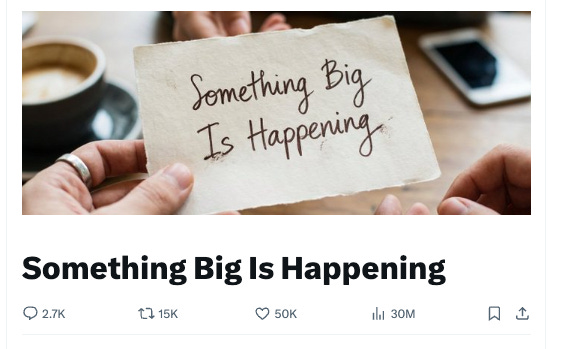
You: "Have you seen what the latest models can do?” In most cases, the answer is no, I haven’t. ... Pointing out to me the power of the models when I say I don’t want to live in Big Tech’s kingdom is like showing me how sleek and efficient a Glock is when I lament violence."

Matt: "Part of the problem is that most people are using the free version of AI tools. The free version is over a year behind what paying users have access to. Judging AI based on free-tier ChatGPT is like evaluating the state of smartphones by using a flip phone."

You freely admit that you're writing from a position of voluntary ignorance, which is exactly what Matt Shumer warns against doing.

I don't want to live in Big Tech's kingdom either. But what you're doing here is like confidently declaring that the loud purring at the door is a dozen housecats and not a lion. If you can really live without ever opening the door, I guess it doesn't matter. But most of us can't. And we'd like to look through the peephole before we do. To unwrap the metaphor, what would "never opening the door" look like in the modern world? Think the Amish. Even the most countercultural among us aren't the Amish.

17 more comments...

No posts

Ready for more?