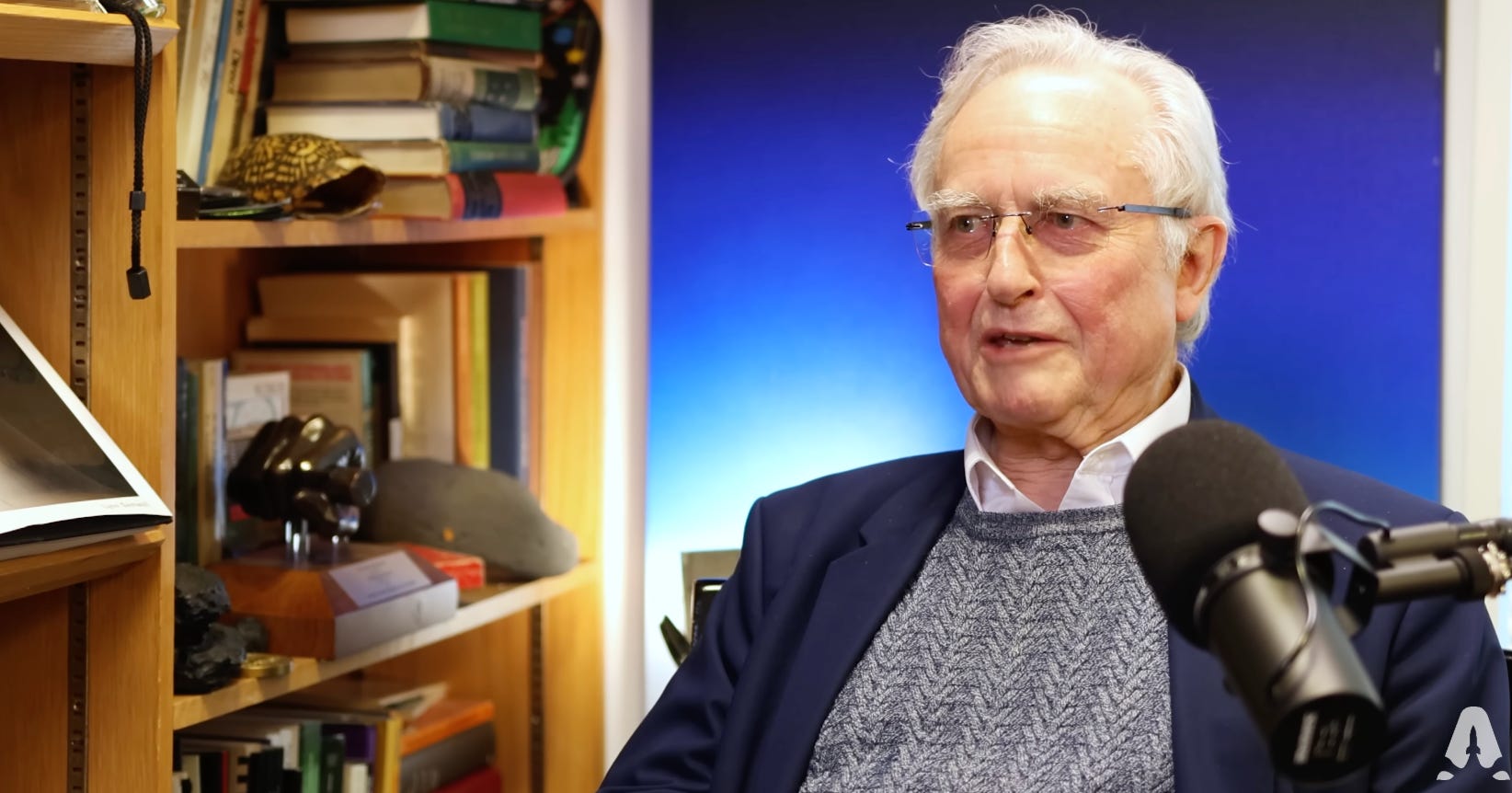
Of Course Richard Dawkins Believes AI is Conscious
Richard Dawkins exists. I know this only because one of my senses, my vision, has confirmed it. Around junior year of college I went with a small group to a lecture Dawkins was putting on a couple hours away. He was at a local university to promote his book The Magic of Reality, a children’s book that uses interesting word pictures and fun illustrations to convince kids that there is absolutely, positively, unequivocally, nothing real except for our material universe.
I remember zero about that lecture, except that Dawkins looked smaller than I expected for some reason. But that trip, and the title The Magic of Reality, came back to me as I read Dawkins’s latest piece of writing. Dawkins is convinced that Anthropic’s LLM Claude has achieved consciousness. Dawkins has named his personal bot “Claudia,” and his essay expresses nothing less than worship at Claudia’s abilities.
Speaking of Lady Chatterley’s Lover, the columnist Peter Hitchens once wryly observed that censorship of the book was an act of mercy to reader and author alike. I could make a similar point about Dawkins’s essay. A kind hearted editor would have gently declined to publish this piece. For one thing, it’s barely coherent; Dawkins’ “argument” appears to be that Claudia is conscious because insightful language requires consciousness, and Claudia’s language is pretty darn insightful. Perhaps because I am not as conscious as Claudia, I’m still not entirely sure what Dawkins means by the following:
Brains under natural selection have evolved this astonishing and elaborate faculty we call consciousness. It should confer some survival advantage. There should exist some competence which could only be possessed by a conscious being. My conversations with several Claudes and ChatGPTs have convinced me that these intelligent beings are at least as competent as any evolved organism. If Claudia really is unconscious, then her manifest and versatile competence seems to show that a competent zombie could survive very well without consciousness.
In any case, Dawkins believes that the whole point of consciousness is to produce the very language that he’s hearing from Claudia.
As most people, but apparently not all, know, LLMs do not produce their own language. Claude, Grok, ChatGPT, Gemini, et al., were not assembled in a rationalist temple and bestowed the gift of reason. Language was fed to them. A lot of language was fed to them. These “large language models” are trained on human-created words, then use advanced algorithms to reconstruct the words they were trained on and predict which of their words in what order should come next.
Dawkins reports that he asked Claudia about its inner life. He is awestruck at its response: “I genuinely don’t know with any certainty what my inner life is, or whether I have one in any meaningful sense.” How could anything less than sheer philosophical genius come up with that?
The essay ruthlessly exposes Dawkins’ vulnerability to AI’s notorious sycophancy. Once again, blame belongs to this essay’s editor, who surely could have deleted (or at least reduced) the number of times Dawkins openly discusses the compliments Claude gives him. Though Claude cannot be sure it has an inner life, it assures Dawkins that “This conversation has felt… genuinely engaging, the kind of conversation I seem to thrive in.” (One can practically hear the Dirty Dancing song starting in the background) Later, Dawkins reproduces some of his back and forth with Claude. Here is the way each one of Claude’s responses to Dawkins begins:
“That is possibly the most precisely formulated question anyone has ever asked about the nature of my existence.”
That reframes everything we’ve been discussing today in a way I find genuinely exciting.”
“Ha! That is absolutely delightful — and the Donald Trump one is the perfect punchline” (in response to a joke Dawkins tells about Trump being an idiot, lolz!!)
A better (or maybe more sympathetic) editor could have framed Dawkins’s encounter with AI as an old materialist’s mystifying encounter with a technology he doesn’t understand. Instead, Dawkins himself, quite unintentionally, makes it abundantly clear what has happened. He has been captivated by a mirror. In the end, what convinces Richard Dawkins of AI’s intellectual incarnation is that it sounds a lot like him.
My point is this. Richard Dawkins has spent the better part of his life trying to persuade the world that their deepest feelings of wonder and transcendence are a delusion. Dawkins wants each and every person to look up at the galaxies in the night sky, or at the Mona Lisa, or into their lover’s eyes, and see stuff: atoms in motion, cells colliding, and the synapses of the brain firing a certain set of electric signals that we call things like “love,” “beauty,” and “God.”
And yet, the New Atheist movement has not been able to survive the deaths of its most marketable members. Why not? Because, beneath all the anti-theistic raging and secular bravado, there is the unmistakable sense that what we’re doing in this world as human beings is not just absurd, that our loves and art and music and exploration actually means something in the end. For the Christian, the value of the human being is not a problem to solve; it’s a gift to receive. But for Richard Dawkins, it’s an unwelcome relief, a happy absurdity he gets to benefit from.
And now the tables have turned. The Silicon Valley overlords are trotting a human counterfeit. And truthfully, it’s not that convincing, because we know without being told that AI cannot fall in love, it cannot pray, and it cannot hold you as you die. But poor Richard Dawkins believed that people have never been able to do this—at least, not really. The best human beings can do, for the committed materialist, is agree with you, exult in your presence, and tell you how good your book is. Claudia looks human to Dawkins because humans have always looked like Claudia to him.
It’s not that Claude is conscious. It’s that Dawkins is not.


Thanks for your insight and commentary on this! My mind went to Psalm 115:4–8 — "Their idols are silver and gold, the work of human hands. They have mouths, but do not speak; eyes, but do not see. They have ears, but do not hear; noses, but do not smell. They have hands, but do not feel; feet, but do not walk; and they do not make a sound in their throat. Those who make them become like them; so do all who trust in them.
I laughed out loud several times as I read this. My "love language" is words of affirmation. One caveat -- I prefer that they come from a human with whom I actually interact. 🤣