

Note: The following is an excerpt from a guest lecture I recently delivered on the question: “What does it mean to be a person?”
The 1998 movie The Truman Show tells the story of a man, Truman Burbank (played by Jim Carrey), who goes about his day in, day out life, completely unaware that he is the star of a 24 hour reality TV show. Every single aspect of Truman’s life is, unbeknownst to him, scripted. His wife, parents, and friends are all actors who have been pretending to be these people as long as he’s known them. Truman’s job, his home city, even the ocean he lives near, are all part of a massive soundstage. Because he thinks his father drowned in a boating accident years ago, Truman is terrified of the water, and thus, doesn’t come close to escaping the boundaries of the soundstage.
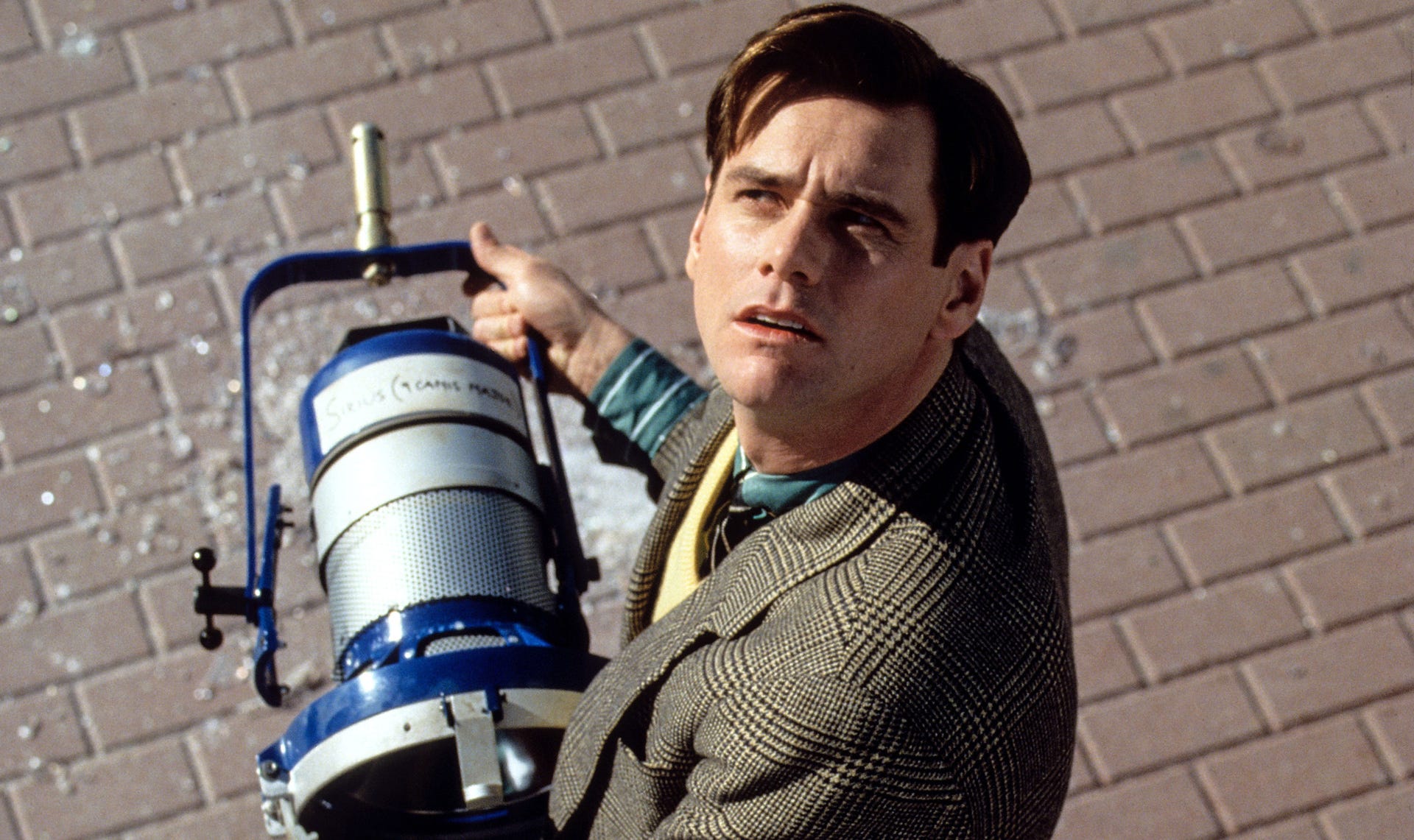
The movie follows Truman as he begins to question why something feels so “off” about his life. His journey toward the truth begins when one an object falls out a completely clear morning sky and nearly kills him. Truman looks closely; it’s a studio light. Later on, Truman is in the car listening to his normal radio show, when all of the sudden the radio starts describing in perfectly accurate detail every turn Truman makes. Then, an argument with his wife takes a bizarre turn when she suddenly stares into space and gives a stiff advertisement for something she bought at the store. These and other events eventually push Truman toward a dramatic showdown with the reality of his situation.
I’ve been thinking a lot about The Truman Show lately, particularly the first half of the film that depicts the inhuman behavior of the people around Truman. It’s inhuman because it’s scripted. It’s on camera. Everything is calculated and controlled. Truman’s thoughts and feelings are genuine, but they are ultimately directed toward nothing. The people and places in Truman’s life are not like him. They perform life, but they signify nothing. They might as well be robots.
That sounds familiar to me.
Ours has become what I call a “planet of bots.” Modern life has become, and been for a while, very “robotified” life. This robotification of all of life has resulted in everyday experiences becoming agonizingly endless experiments in how long you can go without speaking to another human being.
The last few years have been the climax, rather than the beginning, of the robotification of the world. LLMs are bringing what we’ve been doing in the last few decades to a logical, profitable, and psychologically addictive conclusion. We have arrived at the AI era perfectly primed to accept the conditions of life on a planet of bots, because we’ve been living that way for a while. We, like Truman, are citizens of a hyper-controlled, hyper-scripted society. Our attention spans are directed at algorithmically customized feeds. Our reading and our conversations are invaded, not with the unavoidable cares of life, but with advertisements, spam, and “for you” highlights.
Now we need to return to the question: What does it mean to be a person, as opposed to a machine? What I want for us this evening is to consider how to live our lives as people on a planet of bots. I confess I do not have any grand political or cultural strategy for rolling back the robotification of the world. I’m grateful for people who think about this, and I’m eager to support it whenever I can. But tonight the question is for us: What does being a person look like for us? We could, of course, go back to very foundations of human identity try to find our answer. We could talk about embodied rationality, spiritual vitality, moral agency, etc. Instead, what I want to give you tonight is one thing. One thing that a human person is and does that a machine is not and cannot do.
Here it is: A human person submits themselves to and endures suffering for the sake of a higher moral purpose.
In a planet of bots, one of the most important ways we can cling to our humanity is to not flee from suffering, but to put ourselves patiently under it for the sake of God’s glory, others’ good, and our growth.
A machine cannot do this. A machine, no matter how intelligent, will always look for the smoothest, most efficient, most optimized way. The planet of bots operates by one rule: Find the most convenient result in the most convenient way. Eliminate all pain points. Reduce everything to the easiest desired result.
I probably don’t have to work hard to convince you this is not the way the Bible talks about life. Jesus said anyone who doesn’t carry his cross won’t wear his crown. Paul said unless we die daily, we will never live forever. Wisdom literature warns us to be wary of too much sleep and too much wine, because life is hard, and we should be like ants who endure the hardship during summer so that we reap the benefit during winter. And underneath all of this is the logic of love. God so loved the world that he gave his only son. The apostle John says if Christ died for us, we ought to lay our lives down for one another. There is no version of the Christian life that avoids suffering, disappointment, struggle, waiting, and death. And any cultural spirit that primes our emotions to desire a version that does avoid this is working contrary to our eternal good.
There are a lot of reasons we could give for why you should not get ChatGPT to write your papers. But I think one reason we should give more time to is this very one. It is good for you to experience the resistance, the friction, and the frustration of having to do your own intellectual work, with limited time and limited ability, because that striving for something in the midst of suffering is part of the heart of what it means to be a person. Your homework is a training ground for much larger things. As Jesus said, he who is faithful in a little will be faithful in much. If you strive in your suffering now, at 12:30 at night, with the assignment on your syllabus, you are training your heart to strive in the suffering 20 years from now, with the sick, needy child on your bed.
Our technological age is an anti-suffering age. This is natural, inevitable, and in a certain way, good. We are given by our creator a mandate of dominion over this world, and alleviation of suffering is one of the greatest ways we exercise that dominion. But the more you try to bring all of your life and all of your society out of any possible experience of suffering, the more you will begin to view the basic exercise of the virtues as suffering to be avoided—no matter how small, like the boredom during a delayed flight, or the banality of crunching some numbers. The very idea of a virtue implies a context in which suffering has made that virtue both hard and necessary. Jesus said if you love those who love you back, what do you gain? We experience the virtue of love not most clearly when we love those who are easy to love, but when we love those drain us, offend us, or don’t return our love. Likewise, we tend to find self-control, whether in our drink or what we click, easier when it’s been a good, fulfilling day. It’s the dark, depressing days where the voice of drunkenness or pronography seems loudest. This isn’t to say that we crave suffering to actualize our virtues. The point is that suffering clearly plays a role in making us truly virtuous.
Bots do not and cannot think this. Digital technology, as it exists under a technocratic regime today, insists that whatever value you find in having to wait, work, or wonder, is minuscule (or even imaginary) compared to the value you can find in making these experiences automate themselves. Let me start to land the plane by thinking about two particular areas where our suffering tempts us toward inhuman relief: Our work, and our relationships.
Work entails suffering. This is as old as Genesis. “By the sweat of your brow” is what God told Adam. Sin does not invent work (Adam was cultivating the garden before sin). Sin does invent frustration. Before sin, Adam’s smallest efforts bore immediate, exponential fruit. After sin, Adam has to tear his own body apart in order to get the ground to yield up bare subsistence. The rest of Scripture is the story of God’s people, not trying to avoid work (that is what the sluggard and the fool do), but trying to work like God works. Working to put order on a disorderly world. Working to provide for those who don’t have enough. Working in a way that acknowledges that our work is actually not the determining factor of anything. The whole point of the Sabbath is this: You work 6 days because work is how you bring glory out of this fallen world. You rest 1 day because God is actually the one working.
The planet of Bots doesn’t understand the Sabbath at all. This is why, despite the fact that most of us work at computers and desks and have to actually pay a gym for the privilege of sweating, the information economy works people into the ground, with high burnout and depression. You don’t get Sabbath without frustrating work, and frustrating work will destroy you without Sabbath. So when the planet of bots says, “You don’t really need to learn this, or figure out how to complete that assignment, or structure that argument. Just get AI to do it,” it is not offering Sabbath without work. It is offering neither work nor Sabbath. That’s why one of the most important questions to ask the AI generation is, “What are you actually going to do with all this saved time?” The answer for 99% of people is: Scroll/stream more.
So instead of that, why don’t we allow the pain and suffering of work in Adam’s world do its virtuous work in us, making us more ready for Sabbath? It’s what we were literally created for. It’s what it means to be a created human.
What about relationships? Relationships entail suffering, too. God’s curse on the fallen world creates both pain in childbearing and conflict in marriage. The apostle James says we are at war with one another because our passions rage within us. We disappoint others who disappoint us. Friends are fragile, covenants are restrictive, honesty is dangerous. There’s no version of human life that avoids this.
The digital age has polarized men and women. Fewer people now have a desire to marry or even date. Why? Partially because we’ve turned to technology to alleviate the struggle of having to encounter someone different than us. When men and women activate their curated algorithmic feeds, they often see viral content that affirms their gendered experience and belittles the opposite sex. The comfort of the screen seems to relieve the pain of relationship, but in reality it makes relationship itself more painful.
To be a human person means to love another at the expense of one’s self. This is what Jesus did for his church. It’s what heroes do for their countries. And, importantly, it’s what Christians are to do for one another. To overcome the planet of bots, to be fully human, we have to encounter others as they truly are, and submit ourselves to the suffering of loving them.
This is not a blanket call to endure abuse or never draw boundaries. Our loves must be ordered. We must love God first, and loving God means loving justice and hating injustice. But most of the time, our crisis of love comes down to a question of whether we are OK having our comfortable lives disrupted, even completely changed, by loving another. Technology says, “You can have your cake and eat it too. You can love others from behind a screen, and still hold onto your own kingdom.” But we’ll find this is not true.
C.S Lewis writes in The Problem of Pain:
From the highest to the lowest, self exists to be abdicated and, by that abdication, becomes the more truly self, to be thereupon yet the more abdicated, and so forever. This is not a heavenly law which we can escape by remaining earthly, nor an earthly law which we can escape by being saved. What is outside the system of self-giving is not earth, nor nature, nor “ordinary life”, but simply and solely Hell.
Remember the Truman Show? Let me spoil it for you. Truman’s escape from the world of the TV show happens one night when he sneaks out of his home in a way the cameras don’t catch. The producers of the show realize he’s not where they’ve been thinking he is. A panicked manhunt ensues. When they find Truman, he has gone sailing across the ocean he’s terrified of. When he finally submits himself to the suffering of winds and waves, then, and only then, is he set free to be really human—to be a “true man” (=Truman).
My goal has not been to convince you not to use certain technologies. My goal has been to make the idea of being a finite creature, made in the image of God, beautiful to you. He Because our technological moment is a moment where we are tempted to doubt this because we terrified of failure. But we don’t need to be. Christians are the one people in the world who have permission to try and fail, and have confidence in the life of suffering. There’s a savior waiting to catch us every time. Technology cannot save us from a life of struggle, failure, and suffering, because not even Christ will save us from that. Christ will save us through that. In Christ, life is laid out in front of you with success on one side and failure on the other, but both meet at the throne of God. Your heart may break. Your dreams may fail. Your hopes may be dashed. But you will only ever fall into the arms of mercy. Your life will never be wasted, your joy will never be empty, and your glory will never fade.
Thank you, Samuel. Your words are a true blessing to me this morning when i am feeling overwhelmed by our data-driven world. God bless you.
Well said and absolutely true. Thank you.