
Why Egalitarians Should Think More Often About Switching Denominations
A brief engagement

This is a thoughtful note by Kaitlyn Schiess. (Using a screenshot because linking does not depict the entire post on one page)
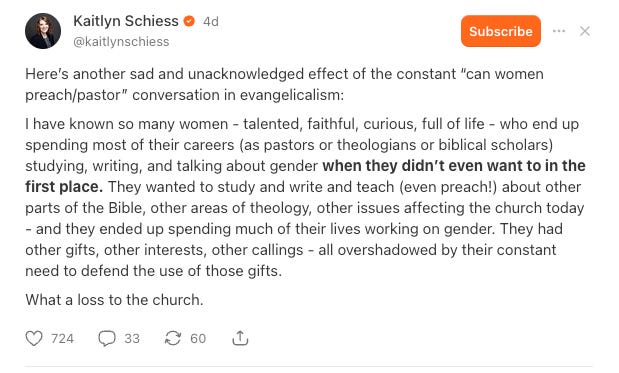
Here’s where I agree with her:
It’s bad for Christians as a whole when any of us feels or acts pigeonholed into a specific lane. It’s bad for three reasons. First, it tends to function as a kind of tokenism, where people become worth listening to only on specific issues that are identity related (gender, race, etc.). Second, obsessing over one particular issue to the exclusion of others is just generally bad for your theological and spiritual health. Third, when people do obsesses over one particular issue to the exclusion of others, they generally become unreliable, not only on other issues but the one issue they’re supposed to be solid on. This happens because Christian truths speak to each other constantly, and trying to isolate one from the rest and expecting good things is like chopping off a body part and expecting the severed limb to keep living and the rest of the body not to bleed.
Gender roles in particular have a tendency to suck the air out of every room they’re in. Partially this is due to the ideological transformations of the 20th century; partially it’s due to the fact that evangelicals have, we may say, struggled mightily on the topic of the body. Though I count myself a complementarian, it’s been a long time since any new argument about gender roles felt compelling or worthwhile.
“Defending the use of your gifts” is indeed an exhausting way to live. It also probably leads to a posture of defensiveness, which is edifying neither to one being defensive or those hearing it.
Confessional Identity is Underrated
But here’s where I want to take her observations in a different direction. I think what Kaitlyn is identifying here is not so much a character problem with evangelicals, who just won’t sit down and let gifted women be gifted women. I think it’s a structural problem borne out of a discontentment with confessional or denominational identity. In other words, when egalitarian women feel frustrated that they have to keep defending the right to use their preaching and teaching gifts, the correct response is to ask, “Where could you use these gifts without having to defend them?” If the answer is different than the tradition in which they currently live, that at least should be a serious reason to change traditions.
Some folks disparage denominational divisions as “disunity” or “necessary evils.” There’s some truth there. There will come a day where Jesus’ body is completely one, and we should yearn for that day. But different denominations also empower a kind of Christian love and respect that can only happen when people acknowledge the reality of their competing beliefs. Specifically, denominations allow Christians to follow their specific biblical convictions in community with others who already share those convictions, instead of always trying to create more of those convictions among a generic body of Christians.
In my now 30+ years of living in evangelicalism, I have noticed that when it comes to the topic of gender roles, egalitarians are rarely content to live and minister inside their aligned confessional lanes.
